Field mice in the house? What Sacramento homes should check
People say “field mouse” for any mouse that seems to have wandered in from outside, and it is not one species. The two that UC IPM compares for homes are the house mouse and the deer mouse.
Telling them apart is worth the minute it takes, because in California deer mice are the ones that spread hantavirus. If you are already seeing droppings or hearing noises, a rodent inspection is where we start.
Why do mice come inside in the fall?
UC IPM says house mice that live outdoors frequently move into homes in autumn, once nighttime temperatures get colder.
Deer mice are more of a closed-building problem. The California Department of Public Health says the chance of breathing in hantavirus goes up when people open or clean buildings that sat closed for the winter after deer mice got in. CDPH’s own list of places to keep mice out of includes the shed and the camper as well as the house.
House mouse, deer mouse or vole?
| Animal | What it looks like | Comes indoors? |
|---|---|---|
| House mouse | Gray all over, tail with almost no fur | Often, in autumn |
| Deer mouse | Bigger eyes, white belly with a sharp line where the darker back fur ends, tail furred and dark on top | Yes, in closed-up buildings |
| Vole | Heavy compact body, short legs, short furred tail, small eyes, ears partly hidden | Rarely |
Voles are the other animal that gets lumped in here. UC IPM calls them meadow mice, says they are poor climbers, and says they usually do not enter homes. They live in dense cover and leave worn runways between burrow openings, so chewed-up lawn edges with no droppings indoors probably point to voles and not a mouse in the house.
What signs should you look for?
UC IPM lists droppings, fresh gnaw marks and tracks as the signs that show where mice are active. House mice build nests out of finely shredded paper or other fibrous stuff, and a big or long-running infestation has a musky smell.
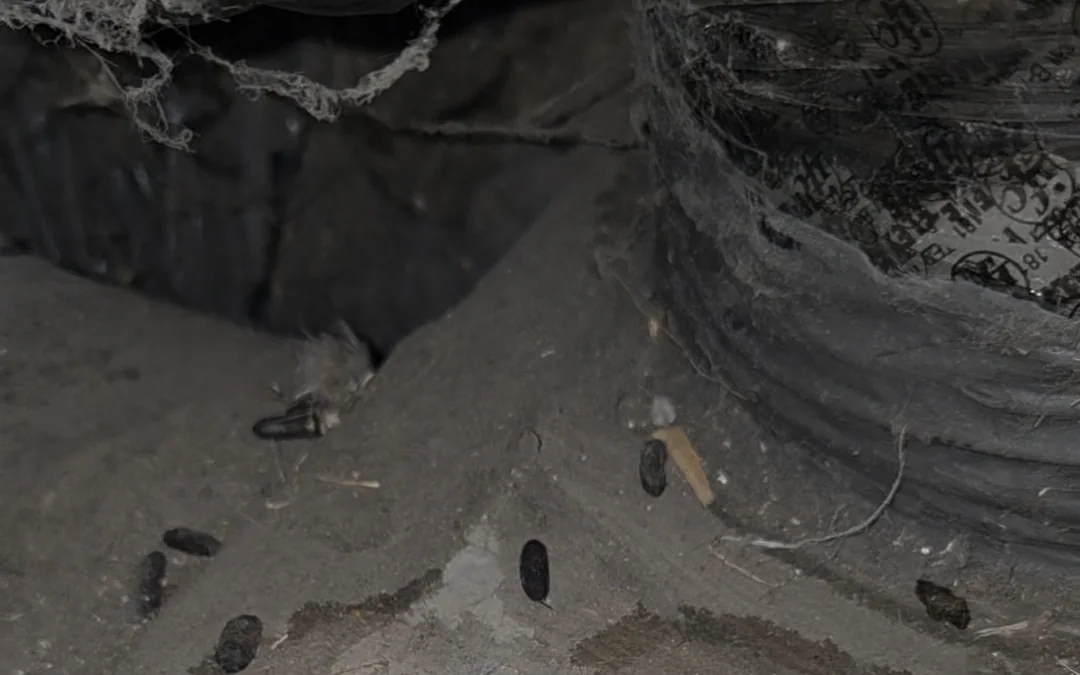
The photo at the top of this page and the one below both come from our own jobs, and you can see droppings beside the air duct and dark specks scattered around the plumbing.
A photo cannot tell you which rodent left them, so an inspection starts with where they are and how they got in.
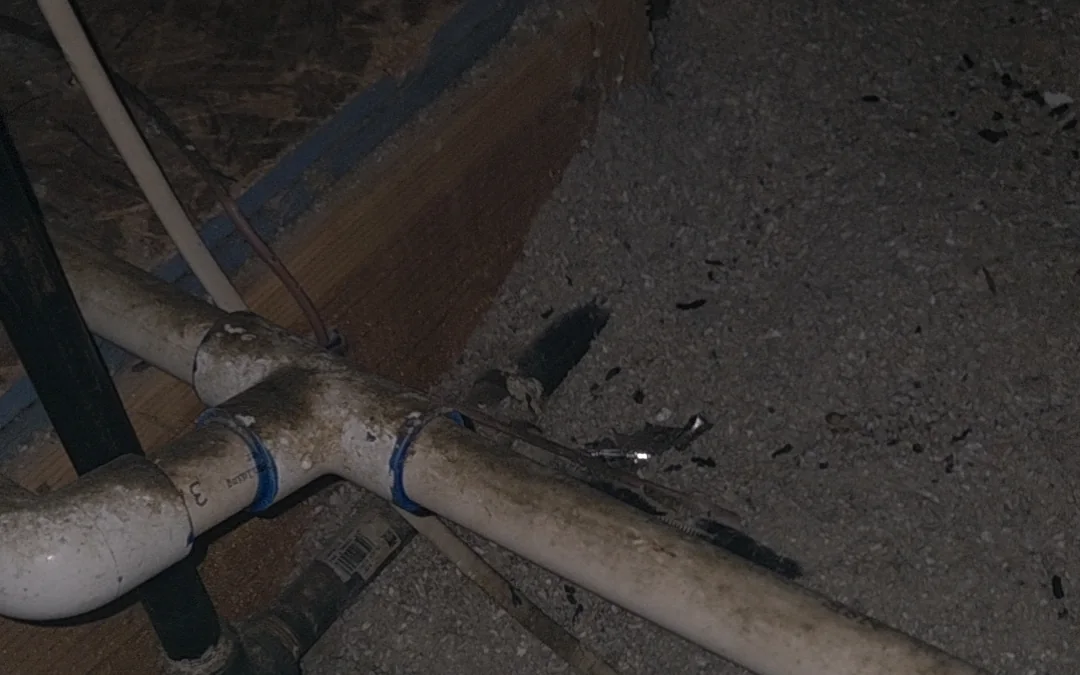
Photograph what you find before you touch it, starting with the pantry and the cabinet under the sink.
Where do they get in?
House mice can squeeze under a gap a quarter inch tall and through an opening three-eighths of an inch wide, per UC IPM. CDPH says to seal any hole the width of a pencil or larger.
Gaps around water pipes, vents and utility cables are the usual suspects, along with cracks in the foundation. UC IPM recommends closing them with metal or concrete. Steel wool works as a stopgap but can rust over time, and plastic, rubber, vinyl, expanding foam and wood all get chewed through.
UC IPM says cleaning and decluttering will seldom control house mice by itself. It adds that poor sanitation draws them in and lets them thrive.
CDPH’s version is to keep all food in rodent-proof containers, and that includes an open bag of pet food sitting on a garage shelf.
How do you clean up droppings safely?
CDPH says not to sweep or vacuum droppings or nests. That can stir contaminated material into the air.
Air the space out for 30 minutes before you start. With rubber or plastic gloves on, spray the droppings with a labeled disinfectant or a fresh 10% bleach solution until they are soaked. Give it at least 5 minutes, then wipe it up with paper towels.
CDPH reports about 3 Sin Nombre hantavirus infections in California a year. Early symptoms look like the flu and usually show up one to six weeks after exposure.
If you get a fever and trouble breathing after cleaning up rodent mess, see a healthcare provider. Mention the rodents, deer mice especially.
Traps or bait?
CDPH recommends snap traps and says not to use glue traps or live traps. UC IPM points out that trapping lets you see whether it is working, and it avoids the smell of a poisoned mouse dying somewhere in the house.
Traps only catch what is already inside, though. Our post on rodent exclusion vs. trapping goes through how the two jobs fit together.
Where we come in
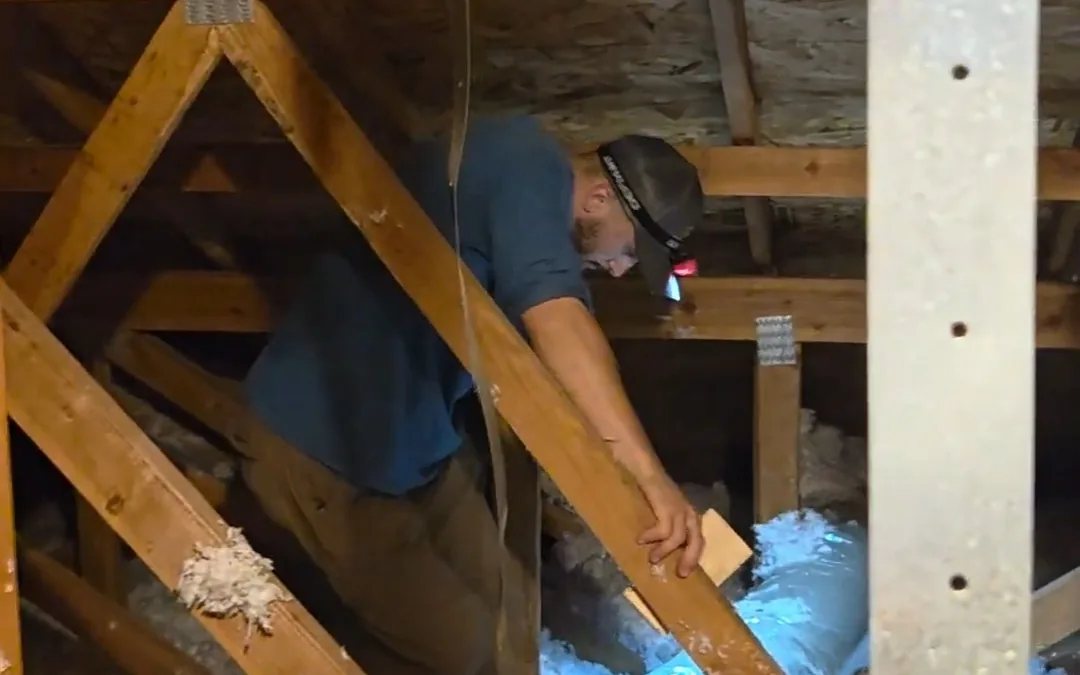
A rodent inspection covers the attic, the crawlspace and the roofline, plus vents, the gap where utilities enter and the garage door seal. You get a plain list of what was found and where.
Rodent exclusion is quoted after that inspection, not before, and quotes start at $500. We work across Sacramento, West Sacramento and the rest of the service area, Monday to Saturday, 7am to 6pm. See our page on pest control in West Sacramento. If the mice are in a Sacramento home, see our Sacramento rodent control page.
If you are finding droppings and cannot see how they are getting in, book a rodent inspection with us at (916) 818-3863.

Residential and commercial pest control. Local technicians treating homes and businesses across Sacramento and the surrounding area.
Services
Service areas
Contact
- Summit Pest Control
- (916) 818-3863
- info@summit-pest-control.com
- 432 Todhunter Ave, West Sacramento, CA 95605
Serving the Sacramento area - Mon-Sat: 7am - 6pm
© 2026 Summit Pest Control. All rights reserved.